
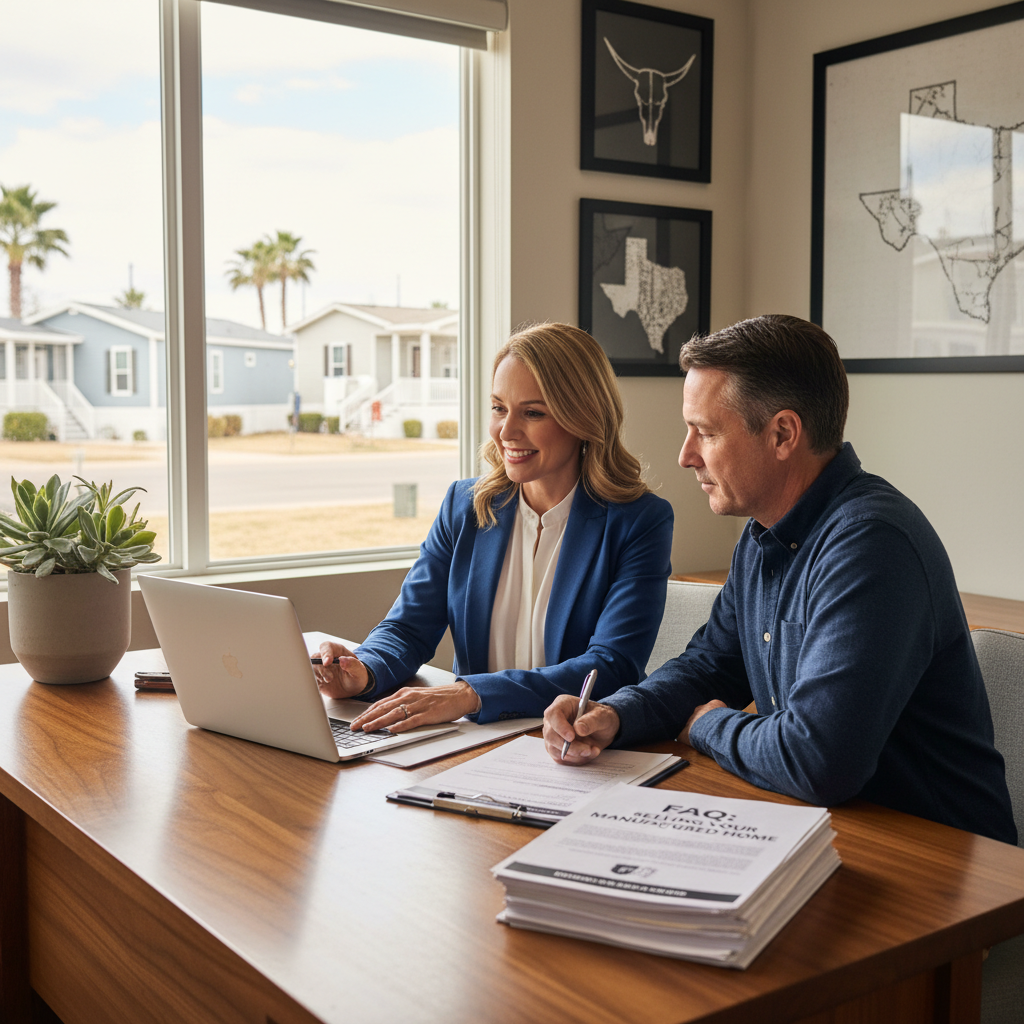
Selling a manufactured home in Texas raises a lot of questions — about titles, pricing, parks, repairs, and the process itself. This FAQ compiles the 50+ most common questions we hear from mobile home sellers across the state, with direct answers based on years of experience as a TDHCA-licensed brokerage. Bookmark this page. Whether you're just starting to think about selling or you're mid-transaction and stuck, the answer you need is here.
Getting Started
How do I sell my mobile home in Texas?
To sell a mobile home in Texas, you need your Statement of Ownership (title) from TDHCA, a bill of sale, and a completed Application for Statement of Ownership. You can sell on-market through a TDHCA-licensed broker, list it yourself (FSBO), or sell off-market to a cash buyer like Mobile Bye Bye. The process involves agreeing on a price, completing the paperwork, transferring the title through TDHCA, and collecting payment. If your home is in a park, you’ll also need to coordinate with park management regarding buyer approval and lease transfer. For a comprehensive overview, read our ultimate guide to selling your mobile home.
How much is my mobile home worth?
Mobile home value depends on the year, manufacturer, model, size (single-wide vs double-wide), condition, location, and whether it sits on owned land or in a park. Homes on owned land are generally worth more. You can check the NADA Manufactured Housing Appraisal Guide for a baseline, but local market conditions matter significantly. A TDHCA-licensed broker can provide a more accurate valuation based on recent comparable sales in your area. Mobile Bye Bye offers free, no-obligation valuations for Texas mobile home owners. For a deeper dive, read How Much Can I Sell My Mobile Home For?
Do I need a realtor to sell my mobile home?
No, you do not need a realtor to sell your mobile home in Texas. However, traditional realtors often lack experience with manufactured home transactions because mobile homes use a different title system (TDHCA Statement of Ownership) than site-built homes. If you want professional help, a TDHCA-licensed manufactured home broker is typically a better choice. You can also sell on your own (FSBO) or directly to a cash buyer. Each method has trade-offs in terms of speed, effort, and net proceeds. Learn more about the differences in our article on whether you should use a realtor to sell your mobile home.
What’s the difference between a mobile home and manufactured home?
Technically, “mobile home” refers to factory-built homes constructed before June 15, 1976, while “manufactured home” refers to those built after that date under federal HUD building codes. The 1976 HUD Code established uniform construction and safety standards. In everyday conversation and real estate, the terms are used interchangeably. For legal and title purposes in Texas, both are handled through TDHCA (Texas Department of Housing and Community Affairs). The distinction rarely affects the selling process, but newer manufactured homes built to HUD standards typically hold their value better.
Can I sell my mobile home if I still owe money on it?
Yes, you can sell a mobile home with an existing loan. The lien must be satisfied at or before closing. If the sale price exceeds your loan balance, the remaining equity goes to you. If you owe more than the home is worth (negative equity), you’ll need to cover the difference or negotiate a short sale with your lender. Cash buyers experienced with manufactured homes, like Mobile Bye Bye, regularly handle transactions involving existing liens and can coordinate directly with your lender to streamline the payoff process. For more about chattel loans, see our chattel loan guide.
How long does it take to sell a mobile home?
Timeline varies significantly by selling method. Selling to a cash buyer can close in as little as 7 to 14 days. Listing with a TDHCA broker typically takes 30 to 90 days. Selling FSBO (for sale by owner) averages 60 to 180 days or longer, depending on pricing, condition, and market demand. Location matters too — homes in desirable parks or on owned land in metro areas sell faster. The TDHCA title transfer itself takes 4 to 6 weeks to process after closing, but that happens after you’ve already received payment. For tips on a faster sale, read How to Sell a Mobile Home Quickly.
What paperwork do I need to sell my mobile home in Texas?
In Texas, you need the following documents to sell a mobile home: your TDHCA Statement of Ownership (the title), a signed bill of sale, a completed TDHCA Application for Statement of Ownership (to transfer the title to the buyer), a valid government-issued photo ID, and any lien release documents if there’s an existing loan. If the home is on real property you own, you may also need a deed. If you’ve lost your Statement of Ownership, you can apply for a duplicate through TDHCA before selling. Our article on the legal side of selling a mobile home covers the full paperwork checklist.
Can I sell my mobile home without a title?
Selling without a title is difficult but not impossible. In Texas, you’ll need to obtain a duplicate Statement of Ownership from TDHCA before completing the sale. This requires submitting an application and paying a fee, and the process can take several weeks. In some cases — such as inherited homes or very old units — you may need to establish an ownership chain through affidavits and supporting documentation. A TDHCA-licensed broker like Ivan Mills at Mobile Bye Bye can help navigate title recovery and complex ownership situations.
Do I need to pay off my lot rent before selling?
You generally need to be current on lot rent to sell your mobile home in a park. Most park leases require lot rent to be paid in full, and the park may refuse to approve a new buyer if there’s outstanding rent. Some cash buyers will negotiate to cover back lot rent as part of the deal — this is common in situations where a seller is behind on payments and needs to sell quickly. If you’re behind on lot rent, talk to a buyer experienced with park transactions before assuming you can’t sell.
What’s the best time of year to sell a mobile home?
Spring and early summer (March through June) are typically the best times to sell a mobile home in Texas. Buyer demand peaks during warmer months, families want to settle before the school year, and homes show better in good weather. However, mobile homes — especially those priced affordably — tend to have year-round demand because they serve the affordable housing market. If you’re selling to a cash buyer, timing matters less since their purchase decisions aren’t driven by seasonal preferences. The worst time is typically late November through January.
Selling Methods
Should I sell my mobile home to a cash buyer?
Selling to a cash buyer makes sense if you prioritize speed, certainty, and simplicity over maximizing the sale price. Cash buyers like Mobile Bye Bye typically close in 7 to 14 days, buy homes as-is (no repairs needed), handle the title transfer paperwork, and charge no commissions or closing costs. The trade-off is that cash offers are usually below full retail value — typically 50% to 70% of what you might get on the open market. If you have time, the home is in good condition, and you’re comfortable managing showings and negotiations, listing on the market may yield a higher price. Read more about the top 25 reasons to sell for cash.
What are the pros and cons of selling my mobile home FSBO?
Pros of selling FSBO (For Sale By Owner) include saving on broker commissions (typically 6% to 10%), maintaining full control over pricing and negotiations, and setting your own timeline. Cons include handling all marketing, fielding inquiries from unqualified buyers, navigating the TDHCA title transfer process yourself, and the risk of pricing your home incorrectly. FSBO homes also tend to take longer to sell and statistically sell for less than broker-listed homes. If you want MLS exposure without a full commission, consider a flat-rate MLS listing service. If you’re considering FSBO, read our guide on the 5 risks of selling FSBO in Texas for a thorough breakdown.
How do TDHCA brokers differ from regular realtors?
TDHCA-licensed manufactured home brokers are specifically licensed by the Texas Department of Housing and Community Affairs to facilitate the sale of manufactured homes. Regular realtors are licensed by TREC (Texas Real Estate Commission) to sell real property. The key difference is jurisdiction — mobile homes classified as personal property fall under TDHCA, not TREC. TDHCA brokers understand the Statement of Ownership system, HUD labels, data plates, installation requirements, and the specific legal nuances of manufactured home transactions. A regular realtor may not know how to handle these, which can cause delays or legal issues.
Can I sell my mobile home on Facebook Marketplace?
Yes, Facebook Marketplace is a popular platform for listing mobile homes for sale. It’s free, reaches local buyers, and allows you to include photos and details. However, be prepared for a high volume of unqualified inquiries, lowball offers, and potential scams. You’ll need to screen buyers carefully and handle all negotiations and paperwork yourself. Marketplace works best as one part of a broader marketing strategy. For a faster, more reliable sale, consider getting a cash offer from a licensed buyer alongside your Marketplace listing to compare your options.
What’s an off-market sale vs on-market sale for a mobile home?
An on-market sale means your home is publicly listed — through a broker, on listing sites, or on platforms like Craigslist and Facebook Marketplace. This exposes your home to more potential buyers and can drive up the price through competition. An off-market sale means the home is sold privately without public advertising — typically to a cash buyer, investor, neighbor, or park manager. Off-market sales are faster and more private, but typically yield lower prices because there’s no competitive bidding. Most cash buyer transactions are off-market. Read our comparison of ways to sell your mobile home in Austin, Texas.
Should I list my mobile home on Zillow?
Zillow can be useful for listing mobile homes, but it has limitations. Zillow’s platform is primarily designed for site-built real estate, and mobile homes — especially those classified as personal property in a park — don’t always display correctly. Many mobile homes simply don’t appear in Zillow’s database. If your home is on owned land and classified as real property, Zillow is a reasonable listing option. For homes in parks, you’re better off using Facebook Marketplace, Craigslist, MHVillage, or working with a TDHCA-licensed broker who knows where manufactured home buyers are looking.
Can I sell my mobile home to my park manager?
Yes, and park managers are sometimes interested in buying homes in their community — especially if they want to control inventory or convert units to park-owned rentals. However, proceed with caution. Park managers may offer below-market prices because they know you have limited options (your home can’t easily be moved). Always get an independent valuation and at least one outside offer before negotiating with your park. Having a competing cash offer gives you leverage and ensures you don’t accept less than your home is worth.
How does owner financing work when selling a mobile home?
Owner financing means you act as the lender — the buyer makes monthly payments to you instead of getting a bank loan. You retain the title until the loan is paid in full. This can attract more buyers (many can’t qualify for traditional mobile home financing) and may allow you to charge a higher sale price. Risks include buyer default, the hassle of collecting payments, and delayed access to your full sale proceeds. In Texas, owner-financed sales of manufactured homes have specific legal requirements under the SAFE Act, so consult with a professional before offering seller financing.
Title & Legal
What is a TDHCA Statement of Ownership?
The TDHCA Statement of Ownership (SOO) is the official title document for manufactured homes in Texas, issued by the Texas Department of Housing and Community Affairs. It proves who legally owns the home and records any liens against it. The SOO replaced the older “Certificate of Title” system. When you sell your mobile home, you must transfer the Statement of Ownership to the buyer by submitting an Application for Statement of Ownership to TDHCA along with the required fees. Processing typically takes 4 to 6 weeks. Without this document, you cannot legally complete a sale.
How do I transfer a mobile home title in Texas?
To transfer a mobile home title in Texas, you need to complete TDHCA Form T (Application for Statement of Ownership), provide the current Statement of Ownership signed by the seller, include a signed bill of sale, submit copies of both parties’ government-issued photo IDs, and pay the applicable fees ($50 for the first section, $25 for each additional section). Both buyer and seller signatures must be notarized. Mail the completed package to TDHCA in Austin. The new Statement of Ownership will be mailed to the buyer in approximately 4 to 6 weeks.
What if my mobile home title has the wrong name on it?
If the name on your Statement of Ownership is incorrect — due to a legal name change, misspelling, or a previous transfer that was never completed — you’ll need to correct it before selling. For name changes due to marriage or divorce, submit a copy of your marriage certificate or divorce decree along with a correction application to TDHCA. For misspellings, contact TDHCA directly to request a correction. If the home was never properly transferred to you, you may need to track down the previous owner or establish the ownership chain through affidavits and supporting documents.
Is my mobile home real property or personal property?
In Texas, a mobile home is classified as personal property by default. It becomes real property only when it is permanently affixed to land that the homeowner also owns and a Statement of Ownership is converted to a real property designation through TDHCA (and sometimes the county deed records). If your home is in a park where you rent the lot, it’s almost certainly classified as personal property. This distinction affects how the home is taxed, how it can be financed, and what type of professional can broker the sale (TDHCA broker for personal property, TREC realtor for real property).
What’s the difference between a title and a deed for mobile homes?
A title (Statement of Ownership from TDHCA) applies to mobile homes classified as personal property — similar to a car title. A deed applies to real property and is recorded with the county clerk. If your manufactured home is permanently attached to land you own and has been converted to real property, the land and home may be conveyed together by deed. If the home is personal property (the most common scenario for park homes), it’s transferred using the TDHCA title system. Some homes that were converted to real property still have a lingering TDHCA record that must be addressed during sale.
Can I sell an inherited mobile home in Texas?
Yes, but you’ll need to transfer the title into your name first. If the deceased owner left a will, you’ll need the probated will and letters testamentary. If there was no will, you’ll need letters of administration from the probate court or a small estate affidavit (if the estate qualifies). Submit these documents to TDHCA along with a death certificate and Application for Statement of Ownership to get the title transferred to you as heir. The process can take several weeks. Ivan Mills at Mobile Bye Bye has handled numerous inherited home sales and can guide you through the title transfer.
What are common title issues with mobile homes?
The most common mobile home title issues in Texas include: missing or lost Statement of Ownership, incomplete ownership chains (previous transfers were never filed with TDHCA), unreleased liens from paid-off loans, incorrect names or information on the title, homes that were never titled after leaving the factory, and inherited homes where probate was never completed. These issues can delay or prevent a sale if not addressed beforehand. A TDHCA-licensed broker can help identify and resolve title problems. Mobile Bye Bye regularly purchases homes with title complications and can often work through them as part of the transaction.
Do I need a lawyer to sell my mobile home?
Texas does not require a lawyer to sell a mobile home. For straightforward transactions — clean title, no liens, willing buyer — you can handle the sale and TDHCA paperwork yourself or work with a TDHCA-licensed broker. However, a lawyer may be advisable if there are title disputes, probate issues, complicated liens, divorce-related ownership questions, or if you’re setting up owner financing. Legal fees for a simple manufactured home transaction typically run $500 to $1,500. Many sellers find that working with an experienced TDHCA broker is sufficient for most transactions.
Pricing & Value
How do I determine the value of my mobile home?
Start with the NADA Manufactured Housing Appraisal Guide, which provides values based on year, make, model, and size. Then adjust for local market conditions, the home’s actual condition, upgrades, and location. Homes in desirable parks or on owned land in metro areas command premium prices. Check recent sales of comparable homes in your area on Facebook Marketplace, MHVillage, and Craigslist. For the most accurate valuation, get a professional appraisal ($300 to $500) or request free quotes from multiple buyers. Mobile Bye Bye provides free, no-obligation valuations for manufactured homes across Texas.
Do mobile homes appreciate or depreciate?
Mobile homes generally depreciate over time, similar to vehicles. However, there are exceptions. Homes on owned land in appreciating markets can gain value because the land appreciates even as the structure depreciates. Well-maintained homes in desirable parks can hold value or modestly appreciate during housing shortages. Key depreciation factors include age, condition, outdated floor plans, and deferred maintenance. The average depreciation rate is roughly 3% to 5% per year for the first 10 years, then slows. Read our detailed breakdown of the top 10 reasons mobile homes depreciate for more insight.
What factors affect mobile home value the most?
The biggest factors affecting mobile home value are: age and year of manufacture, size (single-wide vs double-wide vs triple-wide), overall condition (roof, floors, plumbing, electrical, HVAC), location (metro area vs rural, park quality, lot rent amount), whether it’s on owned land or rented lot, manufacturer and model reputation, upgrades and renovations (kitchen, bathroom, flooring), and local housing market conditions. Of these, location and condition tend to have the largest impact. A well-maintained double-wide in a desirable Austin-area park will be worth significantly more than the same home in a rural community.
How much does location affect mobile home value?
Location is one of the most significant value drivers for mobile homes. The same home can be worth dramatically different amounts depending on where it sits. Key location factors include: the metro area (Austin and San Antonio homes command higher prices than rural areas), the specific park or community (well-managed parks with low lot rent are more desirable), proximity to employment, schools, and amenities, and the lot situation (owned land vs leased lot). A single-wide in a quality Austin-area park might sell for $30,000 to $60,000, while the same home in a remote rural area could fetch $10,000 to $20,000.
Is the NADA guide accurate for mobile home values?
The NADA Manufactured Housing Appraisal Guide provides a useful starting point, but it has limitations. NADA values are based on national averages and don’t account for local market conditions, specific park desirability, lot rent costs, or the home’s actual condition beyond basic categories. In hot markets like Austin, actual selling prices may exceed NADA values. In slower markets, homes may sell below NADA. Think of NADA as one data point, not the definitive answer. Always supplement NADA with local comparable sales research and, ideally, a professional opinion from someone who knows your specific market.
Why do cash buyers offer less than market value?
Cash buyers offer below full retail value because they’re providing speed, certainty, and convenience that have real monetary value. When you sell to a cash buyer, you avoid months of marketing, showings, and uncertainty. You skip repair costs, pay no commissions, and have no closing costs. The buyer assumes all risk — title issues, repair costs, and resale risk. Think of the discount as paying for convenience and guaranteed execution. A typical cash offer runs 50% to 70% of retail value. For many sellers, the net proceeds after accounting for carrying costs, repairs, and commissions end up close to what a cash buyer offers.
Should I get an appraisal before selling my mobile home?
A professional appraisal ($300 to $500) can be useful but isn’t always necessary. Get an appraisal if you’re selling on the open market and need to set a competitive asking price, if there’s a dispute about value, or if the buyer is financing the purchase through a lender that requires one. You probably don’t need an appraisal if you’re selling to a cash buyer (they’ll do their own valuation), if you have good comparable sales data, or if the home is older and the cost of the appraisal represents a large percentage of the home’s value. A free valuation from a TDHCA broker is often sufficient.
How much are closing costs for selling a mobile home?
Closing costs for selling a mobile home in Texas are typically lower than for site-built homes. Common seller costs include: TDHCA title transfer fees ($50 for the first section, $25 for additional sections), broker commission if using one (6% to 10%), any outstanding lien payoffs, prorated lot rent and taxes, and notary fees ($5 to $15). If you sell to a cash buyer like Mobile Bye Bye, they typically cover all closing costs and title transfer fees — your offer amount is your net proceeds. For FSBO sales, budget $100 to $300 for paperwork and fees.
Park-Specific Questions
Can I sell my mobile home if it’s in a park?
Yes, you can sell a mobile home located in a park. You own the home even though you lease the lot. However, most park leases include provisions that affect the sale: the park typically has the right to approve the new buyer, the buyer must qualify for a new lot lease, and some parks charge a transfer fee or require a background check. In rare cases, parks may have a right of first refusal — meaning they can match any offer you receive. Read our complete guide on how to sell a mobile home in a park the right way for detailed steps.
Does the park have to approve the buyer?
In most cases, yes. Park leases typically require management to approve any new resident. The park will usually run a background check and credit check on the buyer and may have minimum income requirements. This is legal — parks have the right to screen tenants for their community. However, the park cannot unreasonably withhold approval. If a buyer meets the park’s published criteria, the park should approve them. If you suspect a park is unfairly blocking buyers, consult your lease agreement and consider seeking legal advice. Having a buyer who is well-qualified makes this process smoother.
What happens to my lot lease when I sell?
When you sell your mobile home in a park, your lot lease terminates and the buyer must sign a new lease with the park. The park sets the terms for the new lease, which may include a different (often higher) lot rent than what you were paying. This is important because high lot rent can reduce your home’s value — buyers factor monthly lot costs into their purchase decision. Before selling, check whether your lease has any transfer fees, early termination penalties, or notice requirements. Give the park adequate written notice that you intend to sell.
Can the park refuse to let me sell?
A park cannot prevent you from selling your own home — you own it. However, the park can refuse to approve a specific buyer for residency if that buyer doesn’t meet the park’s screening criteria. The park can also make selling more difficult by raising lot rent to discourage buyers, charging high transfer fees, or imposing strict move-in requirements. If you feel a park is acting in bad faith to prevent your sale, document everything and consider consulting a tenant rights attorney. In Texas, manufactured home community regulations provide some protections for homeowners. For more on your rights, see our guide on how to fight eviction in a Texas mobile home community.
Do I need the park’s permission to sell?
You don’t need the park’s permission to sell your home, but you typically need them to approve the buyer as a new resident. These are different things. You have the right to sell your property to anyone. The practical challenge is that most buyers won’t purchase a home in a park unless they’re approved for a lot lease. So while you don’t need permission to sell, the park’s cooperation is effectively required for most in-place sales. This is why selling to an experienced cash buyer can help — companies like Mobile Bye Bye have established relationships with parks across Texas.
What if the park wants to buy my home at a low price?
Some parks will offer to purchase your home, often at a below-market price. They do this to convert owner-occupied homes into park-owned rentals, which generates ongoing revenue for them. Before accepting a park’s offer, get at least two independent offers for comparison — one from a TDHCA broker’s market analysis and one from a cash buyer. This gives you leverage. Parks know that if your home is moved out, they lose the lot rent revenue, so their offer isn’t purely based on your home’s value — it reflects their business interests. Never accept the first offer without shopping around.
Can I sell just the home and not the land lease?
Yes — when your home is in a park, you’re always selling just the home (personal property) since you don’t own the land. The buyer will negotiate their own lot lease with the park. This is actually the standard transaction in park settings. Your lot lease simply terminates when you vacate. If you own both the home and the land, you can choose to sell them together or separately, though selling together is usually simpler and yields a higher combined price. Selling the home separately from owned land requires careful handling of the property classification with TDHCA.
What are the rules for selling in a 55+ community?
Selling in a 55+ (senior) community follows the same basic process, but the buyer pool is restricted. Under the Housing for Older Persons Act, at least 80% of occupied units must have at least one resident who is 55 or older. This means your buyer (or at least one co-occupant) must meet the age requirement. The park will verify age compliance during buyer screening. The restricted buyer pool can mean longer selling times and potentially lower prices. However, many seniors specifically seek 55+ communities for the quieter lifestyle, so there is consistent demand. Price your home realistically given the smaller buyer pool.
Repairs & Condition
Should I fix up my mobile home before selling?
It depends on your selling method. If you’re listing on the market for retail value, strategic repairs can increase your sale price — focus on high-impact, low-cost improvements like fresh paint, clean carpets, working fixtures, and curb appeal. If you’re selling to a cash buyer, skip the repairs — cash buyers purchase homes as-is and their offer won’t increase proportionally with your repair investment. We always recommend getting an as-is cash offer first so you can calculate whether the cost of repairs will actually net you more money. Read our guide on 5 things to do before putting your mobile home on the market.
Can I sell a mobile home that needs major repairs?
Yes. Many mobile homes are sold in as-is condition, even with significant repair needs. Cash buyers and investors specifically look for homes that need work because they have the crews and resources to renovate efficiently. Major issues like roof damage, foundation problems, plumbing failures, and electrical issues will reduce the offer price but won’t necessarily prevent a sale. Mobile Bye Bye purchases mobile homes in any condition throughout Texas — from move-in ready to homes that need complete renovation. The key is to be transparent about known issues so the buyer can make an accurate offer.
What repairs give the best ROI before selling a mobile home?
If you’re going to make repairs before selling, focus on these high-ROI improvements: deep cleaning and decluttering (highest ROI at almost no cost), interior and exterior paint ($500 to $1,500, can add $2,000 to $5,000 in value), replacing damaged flooring ($1,000 to $3,000), fixing leaky plumbing and running toilets ($200 to $800), ensuring all appliances work, basic landscaping and skirting repairs, and replacing broken windows or damaged doors. Avoid over-improving — don’t install granite countertops in a 1990s single-wide. The goal is to make the home clean, functional, and move-in ready without overcapitalizing.
Can I sell a mobile home with water damage or mold?
Yes, but you must disclose known water damage or mold issues to the buyer. Texas law requires sellers to disclose known material defects. Water damage and mold are among the most common issues in manufactured homes, particularly around windows, roofs, and plumbing penetrations. These issues will significantly reduce your sale price on the open market. Cash buyers who specialize in manufactured homes routinely purchase homes with water damage and mold because they have remediation teams in place. Don’t try to hide these problems — experienced buyers will find them during inspection, and concealment can expose you to legal liability.
Do I need to pass an inspection to sell my mobile home?
Texas does not require a seller to pass an inspection to sell a manufactured home. However, some buyers — especially those using financing — may require an inspection as a condition of the sale. FHA and VA loans for manufactured homes have specific condition requirements that must be met. Cash buyers typically do their own walkthrough rather than requiring a formal inspection. If you’re selling through a park, the park may have its own requirements regarding the home’s exterior appearance and condition. Selling as-is to a cash buyer is the simplest way to avoid inspection-related hurdles.
Specific Situations
Can I sell my mobile home during a divorce?
Yes, but both parties listed on the title must agree to the sale and sign the transfer documents. If the mobile home is community property (acquired during the marriage), both spouses have equal ownership rights regardless of whose name is on the title. If there’s a court order dividing assets, follow the order’s terms. Some divorce agreements grant one spouse the right to sell; others require mutual consent. Selling to a cash buyer can expedite the process and avoid prolonged disagreements about listing price, repairs, and timing. Consult your divorce attorney before proceeding.
How do I sell a mobile home I inherited?
First, transfer the title into your name through TDHCA. You’ll need the death certificate, probated will or letters testamentary (if there was a will), or letters of administration or small estate affidavit (if there was no will). Submit these with a TDHCA Application for Statement of Ownership. Once the title is in your name, you can sell normally. If the home is in a park, you’ll also need to address the lot lease — some parks will let you keep the lease temporarily while selling, others may not. Ivan Mills at Mobile Bye Bye has extensive experience with inherited manufactured home sales and can help streamline the process.
Can I sell a mobile home with a lien on it?
Yes, but the lien must be satisfied at closing. The most common approach is to use the sale proceeds to pay off the lien, with the remaining balance going to you. If you owe more than the home is worth, you’ll either need to bring cash to closing to cover the shortfall or negotiate a lien release with your lender. Common liens on mobile homes include chattel loans, personal property tax liens, lot rent liens, and mechanic’s liens. Cash buyers experienced with manufactured homes regularly handle lien situations and can coordinate directly with lienholders for payoff amounts and release documentation.
How do I sell a mobile home if I’m behind on lot rent?
Being behind on lot rent makes selling more urgent but not impossible. The park may have a lien on your home for unpaid rent, and some parks will initiate eviction proceedings that could result in losing your home entirely. Your options are: sell quickly to a cash buyer who can close before the situation escalates (some buyers will cover back rent as part of the deal), negotiate a payment plan with the park to buy time for a market sale, or work with a TDHCA broker to find a buyer fast. Don’t wait — the longer you delay, the more back rent accumulates and the higher your risk of eviction. Call Mobile Bye Bye at 737-214-0172 for a same-day offer.
Can I sell a mobile home that’s been abandoned?
Selling an abandoned mobile home is complicated because establishing ownership is difficult. If you’re the titled owner who left the home, you can still sell it — but you may owe back lot rent and taxes. If you’re a park owner or lot owner with an abandoned home on your property, Texas has specific legal procedures for claiming abandoned manufactured homes through TDHCA, including posting notices and filing an application for an abandoned title. The process typically takes 60 to 90 days. You cannot simply sell someone else’s abandoned home without going through the proper legal channels.
How do I sell a double-wide vs single-wide?
The selling process is the same for both, but there are practical differences. Double-wides are generally worth more (often 1.5 to 2.5 times a comparable single-wide), attract more buyers (families prefer the extra space), and are more difficult and expensive to move. Single-wides are easier to sell to investors and move if needed. For TDHCA title purposes, a double-wide has two HUD labels and two sections listed on the Statement of Ownership, so title transfer fees are slightly higher. Marketing strategy may differ — double-wides appeal more to owner-occupant families, while single-wides attract both families and investors. Learn more about selling a mobile home that needs to be moved.
Still have questions? Ivan Mills and the Mobile Bye Bye team have helped hundreds of Texas families sell their manufactured homes. Whether your situation is simple or complicated, we’re here to help. Call us at 737-214-0172 or get in touch online for a free, no-obligation consultation.